
Personality, Shmersonality: On Creating New Problems Instead of Solving the Old
In other news, inflation just hit a three-year high.

Humble royals are more common than humble presidents. That isn’t to say humble royals are common—I have to imagine that being doted on and adulated throughout your formative years would be, well, formative—but hereditary royals did not choose to be who they are and may not be the sorts to seek out such positions were they not born to them. Each and every American president after our first, however, has thought, and has continued to think in the face of vociferous, unrelenting opposition, “I should be in charge of this entire country”; plenty, I think, have also continued to think, again in the face of vociferous, unrelenting opposition, “I am in charge of this entire country and I am absolutely nailing it.”
Which is all to say that if your goal is to seek out America’s paragons of self-effacing virtue, you should likely steer clear of our various seats of government.
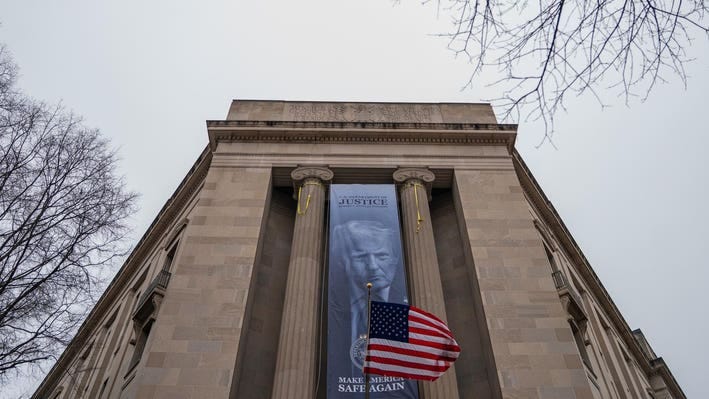
But, even considering the choice of President Biden to pursue a second term against the strong advice and urgings of his own body, not to mention about 90% of Americans not then in his employ, President Trump has broken new ground. This article was prompted by a text from a friend this morning with a screenshot of a proposed $250 bill adorned by the President’s now-familiar official second term portrait, which portrait the President has had his administration put everywhere from the National Parks and Federal Recreational Lands Pass (a little weird) to a banner hanging outside the headquarters of the U.S. Department of Justice (weirder).
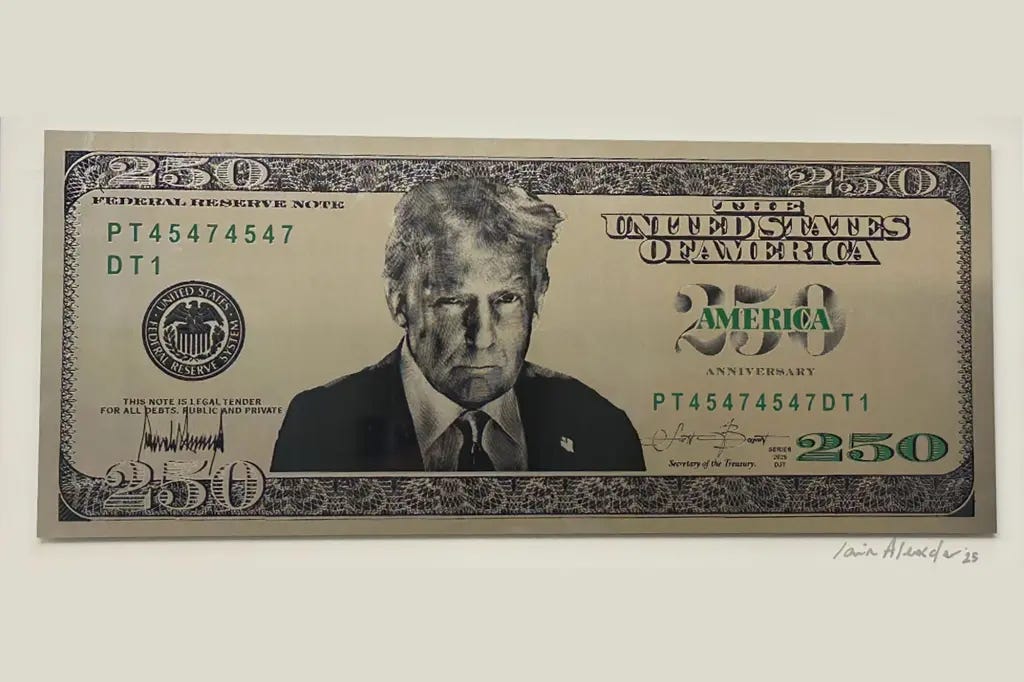
The commemorative $250 bill—with some luck and an act of Congress, you’ll soon only need a single piece of currency to purchase an entire tank of gas.
The President’s self-reverential amorality and constant self-promotion have legitimately benefited him throughout almost his whole life. Whatever his bona fides as a real estate developer and entrepreneur—a subject for another day, but they are disputable—he has achieved immense success as a personality. He has monetized the idea of Trump to the tune of billions of dollars. The man is and has long been an honest-to-goodness star.
But in his current position as the President of the United States, a role scholars consider best filled by George Washington, Thomas Jefferson, Abraham Lincoln, Teddy Roosevelt, and Franklin Delano Roosevelt, Trump’s personality, in perception and reality, creates far more problems than it solves.
*************
Donald Trump wants to be a great president. He wants to be remembered as a great president. The Atlantic recently published an article describing how Trump, recognizing the differences between himself and American heroes like Washington and Lincoln, has been thinking of himself as a successor to Alexander the Great, Julius Caesar, and Napoleon Bonaparte, whom German philosopher Georg Hegel described as “unlikely ‘heroes of an Epoch’ for upending established orders that had previously seemed fixed. They were ‘practical, political men’ who were each condemned in their age for smashing norms and for other conduct ‘obnoxious to moral reprehension’—as Trump has been accused of, centuries later.”
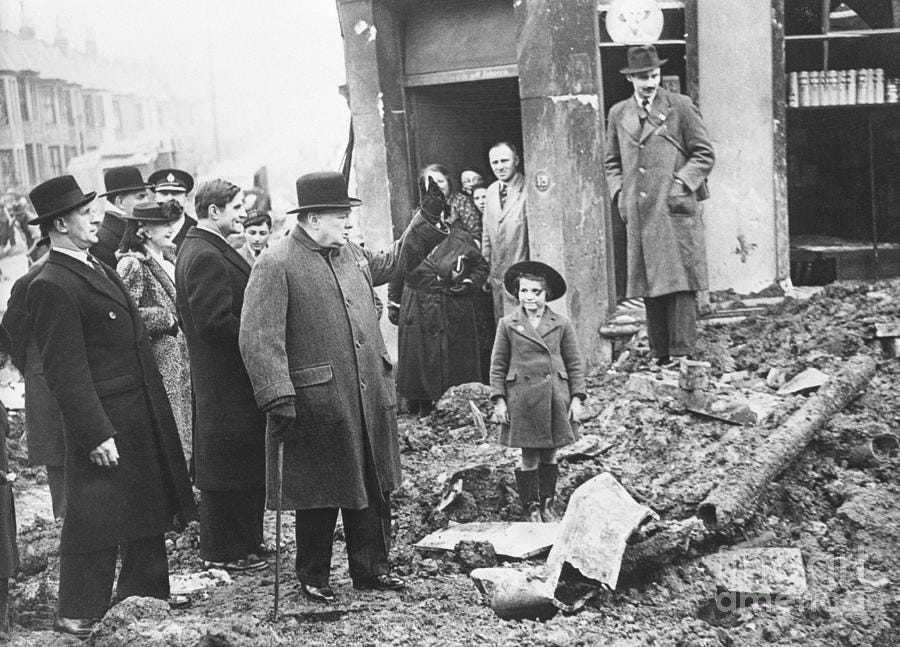
The Atlantic’s article is an exquisite example of elitist puffery. Setting that aside, the point that Trump cares about his legacy is well-taken. A political leader’s legacy is a function of the size of their “moment,” or the defining challenges of their time, and the degree to which they meet that moment. Legacies are not static, as everything remains subject to interpretation and reinterpretation by future generations operating under new parameters, but I believe the general rule holds. Everyone knows the names of Washington, Lincoln, and Churchill, and I think most could give you a short explanation as to why they mattered, but I doubt the average person could tell you anything beyond that. Churchill was in Parliament for all but two years from 1904 to 1955 and served in a laundry list of impactful roles other than Prime Minister, including (not in chronological order) Chancellor of the Exchequer, President of the Board of Trade, Minister of Munitions, Home Secretary, First Lord of the Admiralty (twice), Secretary of State for War and Air, and Secretary of State for the Colonies. From before and throughout his political career, he was vocationally a writer—he published more than 40 books, plenty of them best-sellers, and thousands of articles. He was one of the most famous men in the world long before World War II. Yet he remains a household name throughout the Western world because he led Britain at perhaps the most critical moment of the past 100 (150? 200? more?) years, and did so successfully. Here on our side of the Atlantic, what the average person could tell you about Abraham Lincoln would likely be limited to: (1) Civil War; (2) he ended slavery; and (3) he may, perhaps apocryphally, have been noted for his honesty.
As far as I can tell—and oh, do I hope this remains true—we are not living through anything so obviously momentous as the Founding, the Civil War, or World War II. However, we are living through what future generations might see as an inflection point.
The share of Americans with no close friends has quadrupled since 1990. Only a third of Americans believe they can trust most people. Pew and Gallup have measured public trust in 10 different institutions for fifty years: Nine of the 10, the military being the lone exception, have experienced a declining level of public trust for four consecutive decades (thank you to Ben Sasse for putting these statistics in a recent op-ed).
The widely held assumption that each successive generation is better off than its predecessor has been upended. Costs for housing, education, and healthcare have exploded, while the job market has stratified. The average millennial—my generation—has 30% less wealth at age 35 than the average boomer did at the same age. Complicating matters further, the richest 10% of millennials have 20% more wealth than the richest boomers did. Success has further concentrated.
Artificial intelligence threatens to further disrupt the disrupted. 93 million Americans work white collar jobs. Even if we assume artificial intelligence, like seemingly every prior technological advancement, will ultimately create more human work than it destroys, it won’t happen overnight, and workers of the old jobs won’t automatically become workers of the new jobs. The individual economic impact on many will be profound, and that’s without addressing its impact on us personally as we outsource more and more of our thinking to sophisticated computer programs. Our brains have a fair amount in common with our muscles, and we will lose what we don’t use.
And, of course, the United States does not exist in a vacuum. We are shifting from a unipolar to a bipolar world. The United States spent decades as the world’s lone superpower following our victory in the Cold War. Now, China is a legitimate competitor and threat. Complicating our ability to restrain China, we have through our own actions—well, President Trump has through his actions—thrust into question the post-World War II world order. You could make the argument it was hanging by a thread already, but, even if true (which is debatable), it feels like we’re trying to solve the issue with scissors.
Take all of this together and what you have is problems and a people that wants its government to fix them, but doesn’t trust it to do so. I know President Reagan said “the nine most terrifying words in the English language are: I’m from the government and I’m here to help,” but it turns out that’s not so bad as “I’m from the government and I’m generally unwilling or, if willing, unable to help; please donate to my campaign.” Competent, efficient, trustworthy governance is a good thing. The perception of competence, efficiency, and trustworthiness might be a better thing. We currently have neither.
That’s the backdrop that exists now, or part of it, but it’s also the backdrop that existed a decade ago when Trump was first elected. At that time, I remember seeing a number of conservative friends, some of them older and properly religious—as in, not the people you’d expect to naturally lean toward a foul-mouthed philanderer who seems as familiar with the Bible as your average Christian is with the Bhagavad Gita—share some version of the following post comparing Trump, then at the peak of his Drain the Swamp™ promise, to a rough-around-the-edges exterminator:
“You’ve been on vacation for two weeks, you come home, and your basement is infested with raccoons. Hundreds of rabid, messy, mean raccoons have overtaken your basement. You want them gone immediately…You call the city and four different exterminators, but nobody could handle the job. There is this one guy however, who guarantees you he will get rid of them, so you hire him. You don’t care if the guy smells, you don’t care if the guy swears, you don’t care how many times he’s been married, you don’t care if he was friends with liberals, you don’t care if he has plumber’s crack…you simply want those raccoons gone! You want your problem fixed! He’s the guy. He’s the best. Period. Here’s why we want Trump: Yes he’s a bit of an ass, yes he’s an egomaniac, but we don’t care. The country is a mess because politicians have become too self-serving. The Republican Party is two-faced & gutless. Illegal aliens have been allowed to invade our nation. We want it all fixed! We don’t care that Trump is crude, we don’t care that he insults people, we don’t care that he had been friendly with Hillary, we don’t care that he has changed positions, we don’t care that he’s been married three times, we don’t care that he fights with Megan Kelly and Rosie O’Donnell, we don’t care that he doesn’t know the name of some Muslim terrorist…
…We’re sick of politicians. We’re sick of the Democratic Party and the Republican Party. We just want this thing fixed. Trump may not be a saint, but he isn’t beholden to lobbyist money and he doesn’t have political correctness restraining him. All we know is that he has been very successful, he’s an excellent negotiator, he has built a lot of things, and he’s also not a politician. He’s definitely not a cowardly politician. When he says he’ll fix it, we believe him because he is too much of an egotist to be proven wrong or looked at and called a liar.
Oh yeah…I forgot…we don’t care if the guy has bad hair either.
We just want those raccoons gone.
Out of your house.
NOW!”
Setting aside that the rant, once erroneously attributed to comedian Steve Harvey, falls somewhere on the objectionable spectrum between impolite and seriously offensive (I took out the most provocative/least productive paragraph), the concept—traditional politicians have failed; it’s time to look outside the party establishments for someone to fix this mess—has merit, at least at first glance.
The problem is that Trump is simply not and never was who he was elected to be, and whatever good he does, or at least whatever normal he does—and these categories, almost no matter where you sit on the political spectrum, are not empty—ends up lost in the tumult caused by his latest completely unnecessary provocation.
Just in the last few months or so on social media, amid hundreds of other posts—if my own phone usage is any guide, never has so much governance been accomplished from the seat of a toilet—President Trump feuded with the Pope, posted an AI rendering of himself as Jesus Christ (or, perhaps, a doctor dressed as Jesus Christ), sent out the f-word and “Praise be to Allah!” on Easter morning, and threatened the end of Iranian civilization. The argument could be made that none of that should matter, but the fact is that it does. Trump deranges people. To lament that and blame the deranged is to blame people for looking at the fellow dancing naked on the podium in the town square instead of asking the fellow to step down and have a sandwich and some pants.
This derangement—perhaps we can call it something like Trump Derangement Syndrome—comes in three primary forms. Sufferers of the first, most famous strain are so bothered by the President’s instability and Olympian obscenity and obnoxiousness they cannot evaluate—or refuse to evaluate—his policies on their own terms. They see the elephant in the room, but only the elephant. They are susceptible to defining their own views using Trump’s as a baseline: Trump is bad, so what he wants is bad, and I shall oppose it; if Trump does not want something, it must be good, and I shall want that thing. This is a simple, appealing, morally satisfying approach to politics, but it leads to terrible ends.
Sufferers of the second, equally-if-not-more pernicious variety view Trump as a David-like hero called from outside the political arena to drain the swamp or rid the world of corruption and exploitation or tell it like it is or do any number of other things of which he has mostly fallen short or enthusiastically done the opposite. He is the fighter standing betwixt them and encroaching evil; but for him, the good in the life we have, or had, would be lost or never regained. They either don’t see the elephant in the room or insist the elephant belongs, and is generally improving the room even as it tusks the walls and poops on the furniture. They also use Trump’s views as a baseline, but in reverse: If Trump wants it, it is good, and I shall support it; if Trump opposes it, so shall I too. If I don’t understand his approach, it must be because he, the consummate dealmaker and, in a pretty literal sense, the most powerful man in the world, is playing a higher game. Maybe feuding with the Pope—for denouncing war, if I understood the dispute correctly—actually serves America’s interests. This approach is similarly simple, morally satisfying, and supremely mistaken.
Sufferers of the third strain are Donald Trump. Instead of focusing concretely on solving America’s problems—perhaps a current, steadily-worsening problem like affordability, or the increasing lack of it—which might legitimately grant him a positive legacy history will not erase, he has assembled the most deliberately onanistic administration in American history and spent valuable political capital in pursuit of a legacy history will either erase or mourn that it can’t.
President Trump is making all of us worse. He, with his lack of virtue, spurs us to forget our own, and, in so doing, makes us so much less able to work together, and so much more likely to elect people who cannot work together because they pledge not to work together. Hidden rot—perhaps what we had before and between—is bad. Exposed rot that is not quickly addressed is worse. Think of corruption and corrosive discourse like black mold: bad in the walls, worse in your lungs.
We are all on the same team. I don’t mean that in the Hallmark card sense—I mean somewhat literally that Republicans and Democrats are proposing different strategies to solve the same bloody team’s problems, not representing different teams entirely. We don’t give out trophies when people win elections. We let them try and fix things for a bit. If they convince us to give them another shot, we do; if they don’t, we don’t. Fixing things in America means making deals among many other parties with their own competing interests. Provoking about half of them to hate you before you get to the negotiating table is a bad strategy.
I rather hope the next president remembers that.
A qualified like Mr. Hagen. First, both Roosevelts contributed to where we are today by rejecting the limited government philosophy of our founders.
Second, working together as private citizens is the American way, not the state and private entities. Think Toqueville.
Third, I do not think Trump has spurred you to forget your virtue.
You may be right that Republicans and Democrats are on the same team trying to debase our founding principles in this year of celebration. Grace, class and style are not incompatible with politics, it was not long ago we had such a president and you may even be old enough to remember him.
So you're closer to the west coast now and I invite you to be my guest at the Ronald Reagan Library (up to 3 admissions) and maybe some In-n-Out burgers after. Take care and good stuff.