
Reflections on Juneteenth

The Emancipation Proclamation, as well-conceived and properly motivated as it was, ended neither slavery nor racism.
As to slavery, from a legal standpoint, the proclamation, signed September 22, 1862, and effective January 1, 1863, addressed only those “persons held as slaves within any State, or designated part of a State, the people whereof shall then be in rebellion against the United States[.]” In so doing, it formally exempted the loyal slaveholding states of Delaware, Maryland, Kentucky, and Missouri, and excluded certain places then held by the Union military, including the 48 Virginia counties now known as West Virginia, the entire state of Tennessee, and New Orleans and 13 surrounding parishes in Louisiana. The Proclamation applied to approximately 3.5 million of the country’s 4 million enslaved people. The nation’s last victims of chattel slavery were not legally freed until the Thirteenth Amendment took effect on December 18, 1865.
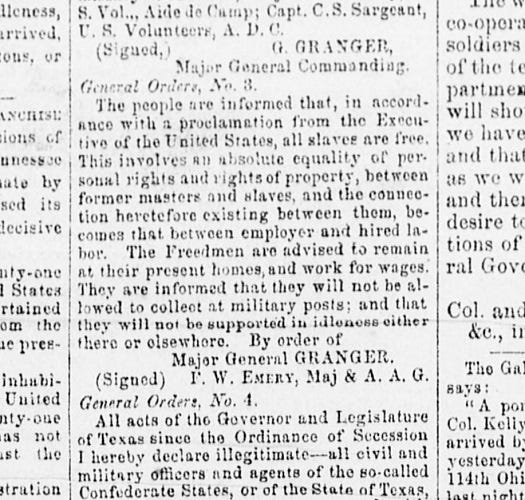
From a practical standpoint, slavery in states subject to the Emancipation Proclamation only ended with advances of the Union Army. On New Year’s Day 1863, approximately 25,000 to 75,000 slaves in Confederate areas under Union control—excepting those already mentioned—immediately gained their freedom, but remaining slaves were obligated to wait for Union advances or attempt to escape. Juneteenth, of course, arises from the date in 1865 when the Union Major General Gordon Granger arrived in Galveston, Texas to take command of 2,000 federal troops and enforce the emancipation of Texas’s approximately 250,000 remaining slaves and oversee Reconstruction.
And, of course, the Emancipation Proclamation and other efforts of the time did not magically make everyone not racist. By way of a Juneteenth-specific example, Maj. General Granger’s order to Texans provided that “The people of Texas are informed that, in accordance with a proclamation from the Executive of the United States, all slaves are free.” So far, so good. “This involves an absolute equality of personal rights and rights of property between former masters and slaves, and the connection heretofore existing between them becomes that between employer and hired labor.” Notable second clause. “The freedmen are advised to remain quietly at their present homes and work for wages.” Ah. Interesting advice. It becomes clear the path from slave to prosperous merchant and engaged member of civil society would be undertaken with, shall we say, limited encouragement.
The common theme is that words, on their own, mean only so much; they must be given life. To proclaim equality is one thing; to effectuate it is another.
*************
The country has changed, but no reasonable person would deny the tendrils of often-vicious, often-formalized anti-Black racism extended far beyond the heat of a Texas summer some 161 years ago. I first began drafting an article about racism in modern America in the early weeks of this second Trump administration, when President Trump’s significant, wide-ranging efforts to end diversity, equity, and inclusion (DEI) initiatives both in and out of the government were briefly at the top of the nation’s mind. There is no question that, over the past few years, the tide has turned against DEI and other formal government or private efforts to redress current effects of historical (or modern) racism. In 2023, the Supreme Court overruled prior cases which allowed colleges to consider applicants’ race within certain Court-prescribed limits; in 2026, the Court further limited the scope of the Voting Rights Act. Conservative activists have gone to great lengths to make public DEI initiatives at various American companies, and have used that publicity to mount pressure campaigns intended to force the companies to change their behavior. Whether fairly or not, DEI was also a weak point for Vice President Harris and Governor Walz: many believe Harris was selected as President Biden’s running mate as much because of her race and gender as her list of political bona fides; Harris became the nominee without facing a primary; and Walz was, in his own telling, chosen in significant part because he “could code talk to white guys watching football and fixing their truck,” calling himself a “permission structure” for those men to vote for a black woman.
The shift looks all the more stark when you remember where we were in the immediate aftermath of George Floyd’s murder in late May 2020. DEI policies were instituted by seemingly every major American organization, from major and minor corporations to President Trump’s Department of Defense. Ibram X. Kendi and Robin DiAngelo became household names, quite likely to the eventual detriment of the cause they support—like many New York City residents who weren’t from the city and whose jobs went remote, my wife and I spent much of the early stretch of the pandemic away, in our case with family in Georgia, Florida, and Utah; I saw the copies of How to Be an Antiracist and White Fragility on the bookshelves and coffee tables of conservative households. Americans who would sooner go full Ozzy Osbourne on a sky rodent than vote for a Democrat marched in parades and, for what turned out to be a rather brief period, opened themselves to race-focused discussions more than at any prior point in my admittedly limited memory.
We find ourselves in a very different position today. However, it remains unclear that the current “consensus,” if we can call it that, will endure—the consensus of six years ago didn’t.
This feels permanent, but so did that. The fundamental problem, at least as to our stance on racism and proposed fixes, is that neither conservatives nor liberals have succeeded in persuading enough people to adopt both their understanding of the problem and the best solution. When Republicans fail to convince Democrats to oppose affirmative action and other DEI policies, it’s often because Republicans fail to make clear they fully understand or accept the severity and recency (or, to some, currency) of American racism; when Democrats fail to convince Republicans to support various efforts at redress, it’s often because they haven’t convinced enough people this particular cure is preferable to—or will even treat—the disease. That largely is a subject for another article (I have approximately 16,000 words in draft, which will be added to and taken away from until a hopefully useful nub remains). What I have today is a personal story that shapes my thinking as to how I think what happened before matters to us now and what we do now can dictate what happens in the future.
*************
My dad is the second of five children, although only just—my uncle, his twin, was born minutes later. The family was not well-off: neither of my grandparents had graduated from college, and the best job my grandpa ever held was that of a store manager for a small, now-defunct chain of sporting goods stores. Leftovers were rare, restaurants once-a-year rare. Until my dad was 12, the family lived in a predominantly blue collar neighborhood on Salt Lake City’s west side, which was and remains dramatically less affluent than the ever-increasingly-wealthy east side where my brothers and I grew up.
But in 1972, my grandparents bought a modest home in the east side township of Millcreek for $29,500—just under $230,000 in today’s money. My dad, previously at the top of the advanced math class, was now at the bottom. He caught up with his new classmates, but it was clear he was dealing with a fundamentally different playing field.
Over the next few years, he and his siblings walked a few blocks up the hill to Skyline High School, one of the best public high schools in the state. Each eventually attended and graduated from the University of Utah—as did my grandmother, who got a job as an administrative assistant for the school’s vice president of development and received a degree in English together with her youngest son—and three went on to graduate school: my dad received a law degree from the University of Utah; his twin brother received an MBA from Brigham Young University (BYU) and a doctorate in public policy from the University of Chicago; and one younger brother got his law degree from New York University. All five married spouses who had also graduated (or would soon graduate) from college, several of them with advanced degrees. My mom, the first child of parents who, like my dad’s parents, had not graduated from college (my mom’s mom, also like my dad’s mom, ended up going back to school, becoming a nurse practitioner when I was young), received bachelor’s and master’s degrees in accounting from BYU. And it’s not like my dad and his family were unique—peers from the neighborhood went on to equal or greater levels of professional success.
How much of that happens if my grandparents don’t move in 1972? How much of it doesn’t happen? Those are unanswerable counterfactuals, but I believe it fair to say the academic and cultural environment into which my grandparents moved my dad and his siblings played an important role in their ultimate success and, by extension, in the success of my generation. The environment in which we are raised matters. What our parents do matters. They are certainly not all that matter, but they matter.
I, like my dad, am a lawyer. I went to a very good school. I worked for a very good firm in New York and work for a very good firm in Salt Lake. I like to think I’ve worked reasonably hard and could fairly be said to be qualified to be where I’m at. I think I can provide legal services commensurate with what you would expect based on my education and place of employ (in some jurisdictions, this may be considered attorney advertising; no, I don’t understand all the rules on that). But my path to where I’m at has been so much easier for having been previously traversed by my dad. Becoming a lawyer—which, for all the many things that can be said of it, is in most material senses a great job—has felt like a normal, achievable thing my entire life. This was my backup: perhaps a surprising thing to say, even more so for it being true, and I think an important part of what makes it true is a cross-town move my grandparents made 54 years ago.
There are multiple takeaways there, one that our actions today can change the fate of our entire family tree, and another that the importance of such individual decisions can reveal a problem with the underlying system—what could have been done in 1972 to improve expected outcomes for the children in the neighborhood my family left?
But the reason I write of this today in particular is because of my mother, not my father. My mom was born in Rome, Georgia, my grandmother’s hometown; she was primarily raised and went to high school in Moultrie, Georgia, my grandfather’s hometown. My mother is young—a year younger than skydiving, sprinting Tom Cruise and six months older than race car-driving, wilderness-surviving Brad Pitt.
When she was born in 1963, the schools in both Rome and Moultrie were still legally segregated.
Just a few years before my white grandparents, limited only by their finances, wanted to make a move and did, there were other white grandparents who wanted to make a move and didn’t; at the same time, there were black grandparents who wanted to make a move and couldn’t (including, incidentally, into the neighborhood to which my grandparents moved—Olympus Cove was formally redlined until the passage of the Fair Housing Act in 1968).
There is much more to say, but for today I’ll stop there.
And on that sober note, Happy Juneteenth!
Random Baseball Trivia: most Americans know the name of Jack “Jackie” Roosevelt Robinson, born into a family of sharecroppers in Cairo, Georgia (36 miles from Moultrie) in January 1919. Robinson is most famous for breaking the MLB color line with the Brooklyn Dodgers in 1947.
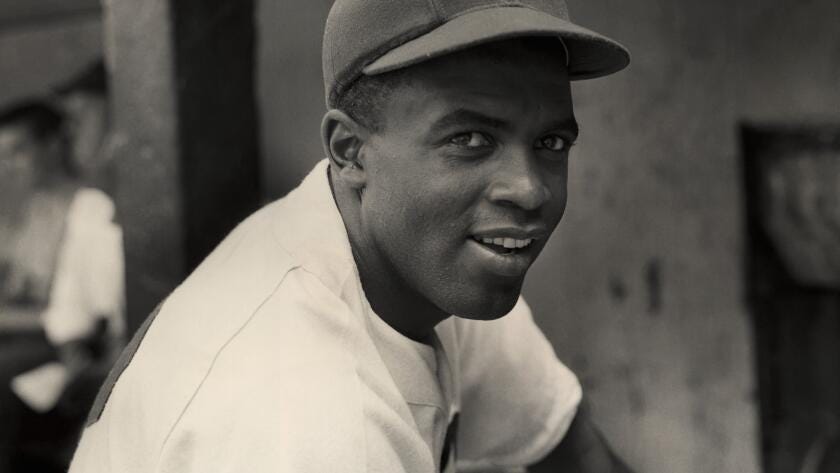
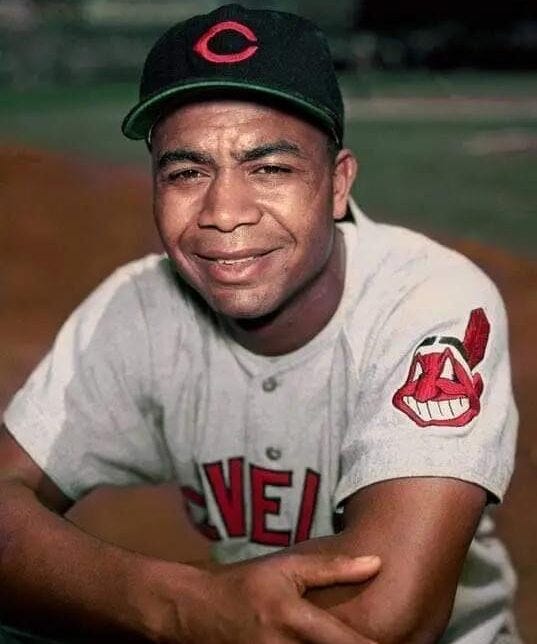
Less well known: (1) just how good Robinson was and (2) Larry Doby, who broke the American League color line three months later with the Cleveland Indians.
First, Robinson, who debuted at the relatively late age of 28, accumulated more wins above replacement (WAR) during his five-year peak from 30 to 34 than every player of the same age range ever but Honus Wagner, Willie Mays, Babe Ruth, Lou Gehrig, and Aaron Judge. Robinson won one MVP over that stretch and, in today’s more stats-focused baseball world, might have won two more. Changing the age range to 30 to 33 moves him also behind Joe Morgan, Rogers Hornsby, and Barry Bonds (entirely pre-steroids, for what it’s worth—34 was Bonds’ first year as an enhanced player). For what it’s worth, every single one of those players either (i) played the entirety of his career before Robinson broke the color line or (ii) is black.
Second, Doby, about 1/10,000th as well known as Robinson today, was a superlative player in his own right. He too enjoyed an MVP-level peak, taking second in 1954 (his fourth-best year WAR-wise), and belatedly joined Robinson in the Hall of Fame in 1998. I don’t know that Doby’s experience in those initial years in the majors was meaningfully less difficult than Robinson’s for his being second. He struggled mightily when he first debuted in 1947 before establishing himself as a far-above-average player as a 24-year-old in 1948. He made his first of seven All-Star teams the next year in 1949.
The guys thought Bobby Bonds was a better player.
Mr. Hagen, once again a reserved like because of the Barry Bonds mention. I loved Bobby Bonds and saw him play at Dodger Stadium. In 1973 (age 12) I was asked by a newspaper who my favorite baseball player was and I replied, Hank Aaron. All the other guys gave me a hard time because they thought Bobby Bonds was. So, it turns out I'm your moms age.
For a little more perspective on race relations you should investigate pre vs. post "Great Society" legislation and read some Walter Williams. He argues and I believe him that black families were more affluent in the pre era.
Oh, and I think the Supreme Court ruled againt an amendment to the Voting Rights Act not the act itself. I think. Good stuff and take care.